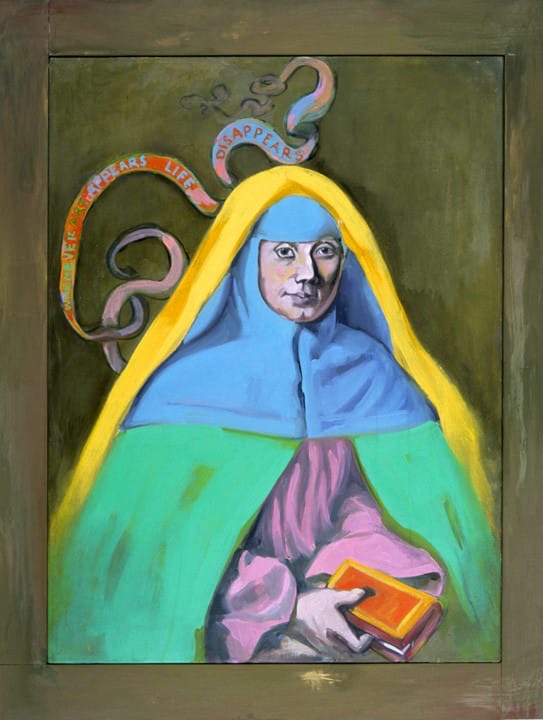

di AM Hoch
Recentemente ho a lungo parlato con Monique Safford – un’artista che vive a New York – del suo lavoro. Questi sono alcuni passaggi delle nostre discussioni. Potete esplorare il suo website di artista in: https://moniquesafford.com/.
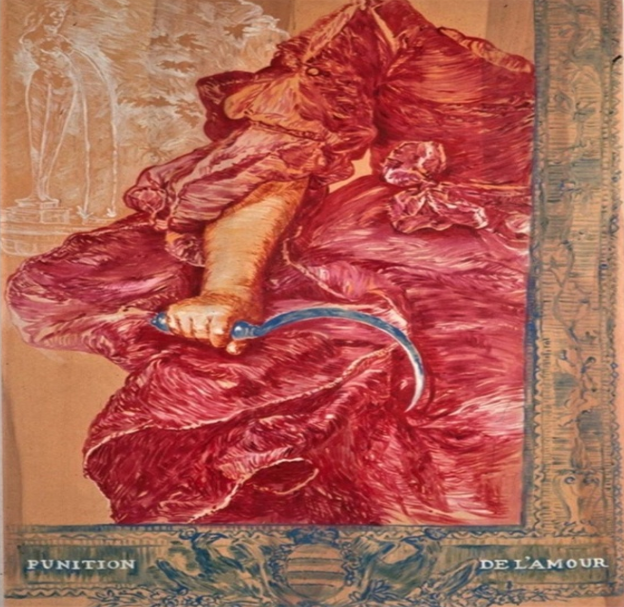
Punishment of Love (1998), olio su pannello, 72×43”
AH: Di recente ho passato tanto tempo online col tuo lavoro, e quello che davvero mi ha colpito è il modo in cui le citazioni dipinte cominciano a riverberarsi su tutti gli aspetti pittorici: i colori, le pennellate, gli strati di colore ricchi di sfumature. E’ quasi un’esperienza cinematografica: tutti questi differenti sensi e parti del cervello stimolati simultaneamente. C’è una geniale sinergia tra i colori, la figurazione pittorica e le parole dipinte, che sono sempre molto cerebrali e sardoniche. Questo crea una straordinaria risonanza che è molto, molto potente. E’ un modo originale e davvero unico di combinare testo ed immagini.
Alcuni hanno una vera avversione verso il testo nell’arte visiva, mentre altri l’amano. Pare che sia qualcosa che provochi una forte reazione, in un senso o nell’altro. Conosco molti che se ne vogliono andare se vedono parole in un dipinto: sono venuti a vedere immagini, non a leggere un testo. Comprendo questa risposta, benché non la condivida. Le parole coinvolgono una parte diversa del cervello ed è un sollievo entrare in un mondo dove non ci sono. Ma nel tuo lavoro entrambe le cose sono totalmente integrate ed essenziali.
MS: L’uso delle parole nel mio lavoro non è stato qualcosa a cui aspirassi consapevolmente: è stato più che altro un impulso. Mi è sembrato naturale. In realtà è così che ho affrontato il mio lavoro fin dall’inizio. Quando frequentavo l’accademia d’arte, la pittura veniva in gran parte rifiutata, mentre l’arte concettuale era dominante. Inoltre, si collegava naturalmente al mio interesse per la letteratura, le citazioni e le idee espresse attraverso il linguaggio. Penso che il mio lavoro sia intellettuale in un modo diverso dal tuo. Ovviamente uso le parole, ma mi interessa meno esprimere direttamente gli stati emotivi.
AH: Torniamo ai tuoi primi lavori, fortemente influenzati dalle stampe storiche e dall’arte della stampa. Mi riferisco ai lavori basati su incisioni del XVIII secolo. Puoi dirci cosa ti ha portato a quel materiale?
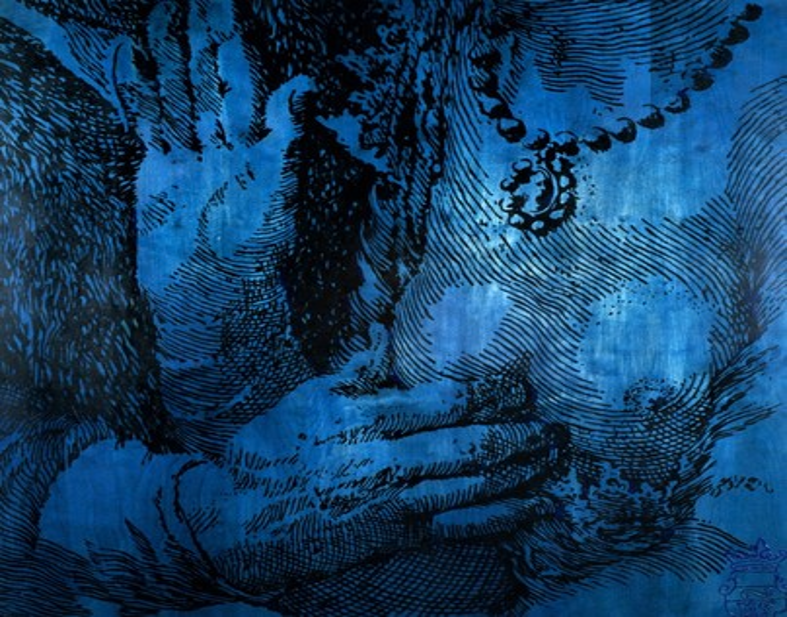
Senza titolo, ovvero Seno blu (1995), colore all’anilina / colore Flashe, 48×48”
MS: Stavo abbandonando gradualmente l’immaginario basato sulla fotografia. Avevo realizzato molte opere che prevedevano l’uso di fotografie di fotografie, insomma tutto quell’approccio tipico dell’arte concettuale degli anni ’70. Il passaggio alle incisioni è nato dal mio interesse per l’immaginario erotico e pornografico del XVIII secolo, in particolare le stampe britanniche.
AH: Dove trovavi quelle immagini?
MS: Libri, biblioteche, manoscritti… ovunque riuscissi a trovarle. Quello che devi capire delle mie prime opere è che si basano in gran parte sull’appropriazione. Non nascono da una profonda fonte di espressione personale, come forse accade nel tuo caso. Si basano sull’appropriazione di immagini e idee che mi interessavano. Il materiale di partenza è cambiato nel tempo, ma quell’approccio di base è rimasto lo stesso. Con le incisioni, prendevo immagini da varie fonti stampate, ne separavo gli elementi, li ricontestualizzavo e aggiungevo del testo.
AH: E tutto questo avveniva prima dell’avvento dei computer, giusto?
MS: Oh sì. Veniva fatto con fotocopiatrici, forbici, colla e proiettori di diapositive.
AH: Quelle tecniche realmente impressionano ora che sono diventate antiquate. Una volta che una tecnologia diventa obsoleta, sembra acquisire una sorta di poesia che non possiede quando è ancora attuale.
MS: Di solito non la vedo in questo modo, ma mi fa piacere sentirlo dire.
AH: Passiamo ora alle tue opere degli anni 2000, in cui il tuo uso della pittura a olio diventa molto più fluido. C’è una sensualità nel modo in cui dipingi e usi il colore in quel periodo, e ovviamente ciò è in netto contrasto con il tono aspro e tagliente di ciò che il testo esprime. Qualcuno che conosce molto bene il tuo lavoro mi ha fatto notare di recente che, se si sa leggere, diventa fisicamente o psicologicamente impossibile vedere qualcosa di scritto senza leggerlo. Per quanto ci si sforzi, non si può fare a meno di leggerlo. Penso che, a un livello inconscio, tu ne sia consapevole e che stia provocando di proposito lo spettatore, dicendogli: «Lo ascolterai, che tu lo voglia o no».
MS: Bene, mi fa piacere che tu la consideri una mia intenzione. Penso che sia molto più impulsivo che intenzionale.
AH: Ma credo che gli impulsi di solito provengano da un luogo molto profondo e inconscio. Ciò che percepisco provenire da un profondo inconscio nel tuo lavoro è una rabbia ribollente. Insisti affinché queste parole vengano lette. È come un prigioniero che incide sulle pareti qualche osservazione arida, ironica, profondamente sarcastica.
MS: Beh, sì. Si basa sul sarcasmo. Non direi ironia, ma è un riflesso di un certo mio capovolgimento sarcastico di questi luoghi comuni sulle donne.
AH: Sì, usi questa strana combinazione di attirare lo spettatore — stuzzicarlo, provocarlo — e allo stesso tempo sedurlo con il colore e una sensualità quasi caramellosa. È una miscela molto “inebriante” perché è piena di contraddizioni. È molto intensa e stratificata, e psicologicamente ed emotivamente densa.
MS: Bene, immagino che abbia a che fare con l’intenzione, ma è una cosa tanto inconscia, come ben sai. Ovviamente cerco di temperare il sarcasmo con qualcosa di piacevole. Il mio sarcasmo, la mia rabbia e tutte quelle emozioni primitive, tra virgolette, non riesco proprio a lasciarle andare come fanno gli altri. Cerco sempre di mitigarle con queste battute sarcastiche. Sono molto inconsapevole di come metto insieme le cose. E’ una cosa che viene semplicemente da dove proviene la scintilla nel fare arte, o nella vita. È davvero, come tutta l’arte, un riflesso della propria personalità. È solo una questione di come la si fa emergere. Per quanto mi riguarda, non potrei mai prendere un’esperienza emotiva davvero intensa – una profonda sofferenza o qualcosa del genere – e inserirla direttamente nell’opera. È sempre smorzata. È sempre trasformata in qualcosa con cui riesco a confrontarmi. Apprezzo molto quel tipo di dipinti in cui gli artisti lavorano d’istinto e riversano ciò che hanno dentro direttamente sulla superficie. Direi che tu sei uno di quei pittori. Non mi sembra di farlo con il mio lavoro. È tutta una traduzione. È quasi come mettere da parte l’emozione, in un certo senso.
AH: Mi chiedo se questo sia collegato al tuo uso di abiti e maniere d’altri tempi. Molti dei tuoi dipinti degli anni 2000 sembrano opere d’epoca. Sono come drammi in costume, il che solleva la domanda: perché? Perché sono tutti travestiti? Perché queste figure indossano cappelli piumati Perché questi personaggi indossano cappelli piumati e abiti di trecento anni fa? Come mai nessuno ha un aspetto contemporaneo? Nessuno parla con un tono contemporaneo.
MS: Sì.
AH: Come, ad esempio, il dipinto di una ragazzina con un cappellino antiquato con volants e la didascalia dipinta: “Meglio in una fogna che su un piedistallo”.
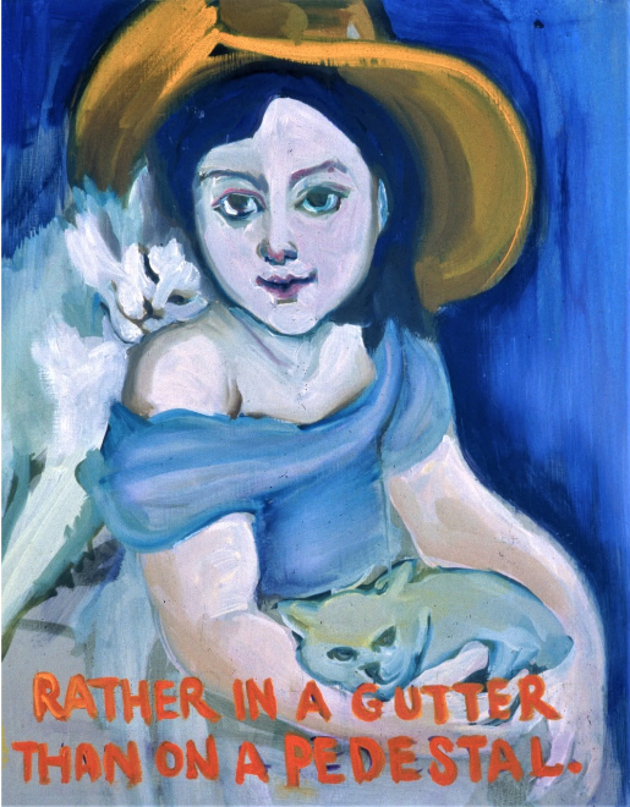
Senza titolo (2002), olio su tela, 50,8 x 61”
MS: L’idea di fondo di quella serie in particolare era prendere questi bambini innocenti, queste concezioni antiquate sui bambini, e sovrapporvi delle citazioni, che sono del filosofo E.M. Cioran. Ho preso moltissime delle sue citazioni e le ho usate per controbilanciare questa rappresentazione ottocentesca dell’innocenza dei bambini. Queste citazioni contraddicono quell’idea. È da lì che mi sono ispirata, comunque. Devi capire che si tratta di dipinti tratti da pittori davvero di seconda categoria. Non è come se stessi guardando le opere di pittori profondi che cercavano di rappresentare qualcosa. C’è tutta una serie di dipinti che rappresentano la vita domestica tutta rose e fiori. Sono davvero dipinti di seconda, terza categoria. Insomma, sono banali. Assolutamente banali. Sai, come quello con la scritta «Meglio in un canale di scolo che su un piedistallo». È una bambina carina che tiene in braccio i suoi gattini, ma quello che sta davvero pensando – o provando – potrebbe essere proprio quella citazione di E.M. Cioran. Ne ha fatte molte. Erano molto sarcastiche, molto negative, ultra- negative, e sono abbinate a questi bambini dagli occhi luminosi. Ma questa è solo un aspetto del mio tocco personale.
AH: Quindi E.M. Cioran era un filosofo, aforista e saggista rumeno del XX secolo, uno degli scrittori che citi molto spesso nei tuoi dipinti. Ce ne sono altri?
MS: No, ma stavo leggendo Cioran e sono rimasto dalla sua negatività, che è uno dei miei temi preferiti. Così ho semplicemente applicato le sue citazioni alle “foto di bambini”. A parte questo, non ho usato nient’altro di suo. La letteratura e la lettura fanno parte dei miei interessi originari e si insinuano nel mio lavoro visivo. Ma per il resto, no, non ho mai usato nulla in modo così diretto.
AH: Scrivi mai aforismi tu stessa? Ad esempio, nel tuo dipinto Somnio Ergo Sum, che è scritto sulla maglietta che indossi in quel quadro, è un tuo aforisma?
MS: È un mio aforisma, sì. Almeno credo che lo sia.
AH: Beh, complimenti per quello. Mi piacerebbe parlare ancora di quel meraviglioso dipinto, ma prima vorrei tornare a quelli precedenti: cosa ti ha spinto a dedicarti all’arte erotica e pornografica?
MS: Sono sempre stata interessata alla scrittura e alle rappresentazioni erotiche. E ho cercato di ribaltarne la prospettiva dal mio punto di vista di spettatrice. La maggior parte di esse risale al XVIII secolo, anche se, ovviamente, la pornografia esiste da sempre, fatta per gli uomini, da uomini. Mi interessava prendere tutti quei luoghi comuni e riformularli dal mio punto di vista di artista, di donna. Non si tratta di un commento particolarmente diretto. Mi piaceva estrapolare completamente quel tipo di immagini dal contesto maschile/erotico e farne qualcos’altro.
AH: Sì, sì. E’ solo una digressione, ma ho sempre molta difficoltà a guardare il canone dell’arte erotica, perché è così funzionale all’eccitazione maschile. Mi fa infuriare perché penso che non sia per me, ma per loro.
MS: Capisco. Non guardo la pornografia contemporanea, non mi interessa. Sono del tutto consapevole che si tratta di un tropo e un’ossessione prettamente maschile. Prendo la loro prospettiva e la trasformo in qualcosa che le si contrappone. E penso che questo faccia apparire le immagini ridicole e sciocche. C’è qualcosa di potente nel riappropriarsi di quel tipo di immaginario.
AH: Sì, assolutamente. Giusto. È meraviglioso sentirtelo dire. Hai accennato al fatto che, quando frequentavi l’accademia d’arte, la pittura non veniva insegnata. C’era un pregiudizio a favore dell’arte concettuale e la pittura a olio non veniva insegnata. Puoi parlarmi del tuo percorso di autoapprendimento della pittura a olio?
MS: Quando frequentavo l’accademia d’arte, il concettualismo era in ascesa, ma nell’accademia che frequentavo [a Los Angeles] la pittura veniva ancora insegnata. Solo questi vecchi che insegnavano pittura. Non ho mai voluto frequentare quelle lezioni. Ora mi sento in colpa, ma non volevo frequentare quelle lezioni e non volevo ascoltare quei tipi. Nella mia scuola non c’erano insegnanti donne. Ho seguito tutti i corsi di base, ma non ero attratta dalla pittura né dall’imparare a dipingere, anche se in qualche modo l’ho fatto, ma non mi interessava. Ho preso la direzione opposta alla sensibilità letteratura, orientandomi verso quella concettuale, che sentivo più vicina ai miei interessi. Fu una specie di ribellione. Ora non posso dire che sia stato un vantaggio per me, ma era l’unico modo per, diciamo così, prendere le distanze.
AH: Sì, sì, capisco perfettamente.MS: E per quanto riguarda l’imparare a dipingere con i colori a olio, in quei primi lavori ho sempre cercato di dipingere con gli acrilici. Quando ero con te nello studio [a New York City negli anni ’90], usavo colori all’anilina su pannelli e Flashe, che è una vernice acrilica molto opaca. E, dal momento che non sapevo nulla di pittura, per così dire, mi limitavo a riprodurre quelle cose con un pennello, non con una penna o altri strumenti per disegnare. E poi ho voluto imparare. Così ho studiato da sola. Insomma, è stato un processo. Ovviamente ho chiesto in giro informazioni sui materiali e cose del genere. Di questo non sapevo nulla.
AH: Ricordi quel processo come emozionante, frustrante, liberatorio, terrificante?
MS: Mi è piaciuto davvero. Ma più dipingevo, più mi rendevo conto di cosa facessi male e degli errori che commettevo. Ci è voluto molto tempo, anche se mi è piaciuto. Ma poi ho semplicemente fatto a modo mio, sai, seguendo il mio istinto. Un altro tipo di ribellione, suppongo. Penso che l’idea alla base del mio impegno artistico sia sempre stata quella di seguire il mio istinto. Il che, guardando indietro, è stata ed è una cosa positiva, ma ho avuto delle difficoltà, dovendo imparare le cose in modo abbastanza casuale.
AH: Quindi ti sei ribellata contro tutto, come si dice che facciano gli artisti. E poi, a un certo punto, hai deciso che sarebbe stato interessante, essenziale o curioso dipingere a olio. Cosa ti ha spinto a voler dipingere a olio?
MS: Ho realizzato quei primi dipinti con il pennello e con il Flashe, quindi c’era qualcosa in quel tipo di piacere che provavo, negli aspetti sensuali della pittura, che non sperimentavo quando facevo lavori basati sulla fotografia. È stata una decisione che ho preso per aprirmi a questa possibilità. E con questo sono scivolata nell’abisso. Anche se non sapevo cosa stavo facendo, ho ricevuto qualche consiglio e ho semplicemente iniziato. Ancora una volta, ho seguito il mio istinto ovunque mi conducesse.
AH: Sì, mi piace. E, come sai, ho assistito ad alcuni di quei momenti di scoperta davvero eccitanti. Penso che per chi di noi dipinge a olio, sia un mezzo straordinariamente emozionante. Ha una volontà propria. Non gli puoi dire cosa fare. Sarà lui a dirti cosa fare quando sarà pronto. È davvero un mezzo affascinante, così seducente e … crudele. Voglio dire, i colori a olio, come sai, sono capricciosi, volubili e inebrianti, ma per chi di noi è loro devoto in maniera quasi servile, è una storia d’amore al di là di ogni immaginazione.
Perciò vorrei portare il discorso sulla tua personale tavolozza di colori. Ricordo molto chiaramente una cosa che hai detto quando mi hai chiesto per la prima volta informazioni su vernici e marche, su quali colori comprare e dove — le solite chiacchiere da negozio, ed è stato davvero divertente — e io ti ho chiesto: “Allora, ti interessano i colori terra?”. E tu hai risposto immediatamente: “No”.
MS: Davvero?
AH: Sì, e lo trovai molto interessante. Mi piacque quel tuo “No” viscerale. Anche se, ovviamente, in un modo o nell’altro bisogna usare i colori terra. Aggiungono solo un livello di profondità, come una linea di basso nella musica, quindi è bello includerli. Ad ogni modo, eri categorica nel dire che non ti interessavano i colori terra. Ti riconosci ancora in questa affermazione? Cosa ne pensi ora dell’uso dei colori terra?
MS: Non ricordo di averlo detto, ma sicuramente non ero interessata a nessun accostamento con i colori terra. Ovviamente ho imparato, come hai appena detto, che bisogna usarli. Ma non so esattamente perché fossi così categorica al riguardo.
AH: Beh, l’impressione che ho avuto è che tu non fossi interessata al mondo terreno. Eri interessata a un mondo assai diverso ed eri entusiasta di dipingere quel mondo in cui volevi vivere, che era nei tuoi quadri. E sembra proprio che, con l’evolversi del tuo lavoro nel corso dei decenni, la tua tavolozza sia diventata straordinariamente vivace. E’ davvero, davvero psichedelica, una sorta di tavolozza da trip da acido, anche se molto più deliziosa e sofisticata di quelle che venivano chiamate “pitture acide” negli anni ’60 e ’70. Ma mi sembra che tu non sia interessata a dipingere il “mondo reale”. Non ti interessa il piano terreno. Sei d’accordo? Ti interessa un paesaggio onirico – un paesaggio allucinogeno, quasi da sballo. E nella mia recente immersione nei tuoi dipinti più recenti, mi ha colpito il fatto che siano simili a graphic novels. Ogni dipinto è un romanzo a fumetti completo – non sequenziale come graphic novels – ma narrativo in un modo veramente unico.
MS: Mah, non l’ho mai considerata una forma narrativa. E non sono nemmeno sicura che si tratti di arte grafica. Penso che ciò possa dipendere dal fatto che il mio lavoro non è ciò che la gente si aspetta quando si parla di “pittura”. Non lo considero “pittorico” nel senso dei dipinti pittorici, come si possono si possono descrivere dei quadri. Ma penso che ci siano scenari che sono immagini tratte dalla storia dell’arte o da una sorta di strada immaginaria che sto percorrendo. Penso che ci siano anche tante altre cose lì dentro, se qualcuno fosse incline a scoprirle o a indagarle. C’è una raccolta di simboli di cose o atteggiamenti. C’è il dipinto che è un commento a La colazione sull’erba [o Picnic sull’erba, di Édouard Manet, 1863], dove da un lato ci sono gli uomini e dall’altro le donne che si tuffano in acqua.
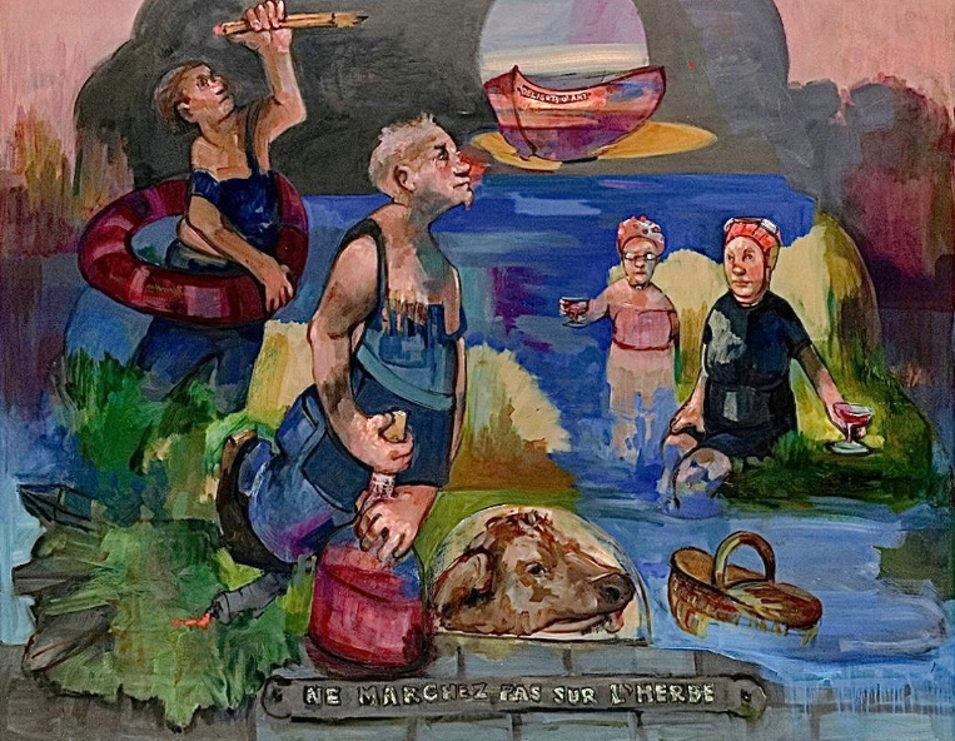
Delights of Art (2019), olio su pannello, 60×48”
AH: Stai parlando di Delights of Art, giusto?
MS: Sì, si tratta di prendere proprio questo dipinto, molto famoso, per esprimere una sorta di visione femminista. È la mia personale ed eccentrica visione femminista. È la stessa cosa che succede quando si sovverte l’erotismo. Prendere queste immagini associate a pittori maschi e rappresentare delle donne che occupano lo stesso spazio. Il dipinto originale è incredibilmente fantastico, ma non sto cercando di riprodurlo. Ho sempre, sempre reagito al dominio maschile, e stiamo parlando di pittura e visioni maschili. Dal momento che non stiamo parlando di dipinti astratti, che è una cosa completamente diversa, e di politica, che è anche molto differente, è la mia reazione nel guardare quei dipinti figurativi di una certa epoca, capovolgendoli.
AH: Sì, sì. Hai detto che ciascuno dei tuoi dipinti è come un rebus e che ogni dettaglio ha un suo significato. Quindi, per quanto riguarda Delights of Art, potremmo parlare un po’ delle specificità dei simboli e delle immagini presenti in quel particolare dipinto? Ad esempio, c’è la testa di mucca, il cestino da picnic, la barca. C’è la figura femminile con un salvagente intorno al corpo che brandisce una matita gigantesca, come fosse un pugnale…
MS: E ci sono due donne in disparte che bevono un bicchiere di vino.
AH: Sì! Per favore, dimmi quello che puoi su quelle immagini simboliche.
MS: La testa di mucca è semplicemente ironica. Voglio dire, perché a un picnic all’aperto c’è sempre una sorta di magnifica esposizione di bottiglie di vino e stuzzichini. Inoltre, gli uomini uccidono gli animali…! L’ho presa semplicemente come una sorta di rappresentazione della mia ostilità repressa. È fondamentalmente un dipinto molto buffo, ma allo stesso tempo aggressivo. Il tipo che sta tirando un tappo, sembra che si stia tirando fuori il cazzo.
AH: Sì, sì, è così.
MS: Ricordo un uomo che tiene in mano il pennello e le donne pare che siano sul punto di tuffarsi nello stagno. Le donne indossano cuffie da nuoto, come se si stessero preparando a tuffarsi nell’oceano tonificante della supremazia maschile. Non so, qualcosa del genere.
AH: Sì, magnifico. Quindi, potremmo dire che la gioia di immergersi nell’arte sia un po’ diminuita dal fatto sei una donna! Quel che fai nei tuoi dipinti è meraviglioso e ricco. Ho pensato che i tuoi dipinti, in particolare i tuoi quadri di grandi dimensioni più recenti, siano aforismi visuali. Uno dei miei preferiti in assoluto è il tuo autoritratto. Ne stavamo parlando proprio all’inizio, “Somnio Ergo Sum”. E una di quelle immagini simboliche è la scimmietta ammaestrata che ti mette in testa la corona d’alloro con la scritta “Ars Longa”. Mettere la corona in testa a un’artista ubriaca e dissoluta, che saresti tu! Penso che sia un autoritratto semplicemente geniale: malinconico e al tempo stesso pieno di rabbia.MS: Ma l’hai riassunto perfettamente! Il tipo di artista dissoluta, nella sua amaca, che sogna allori ma senza fare granché. E la scimmia rappresenta i riconoscimenti tradizionali che vengono conferiti alle persone di successo. L’essere che esegue il gesto è una scimmia, che, come sai, rappresenta la follia e la vanità.
AH: Sì, le creature addomesticate che sono state private della loro dignità. E apprezzo tanto le tue osservazioni sull’essere un’artista in una professione dominata dagli uomini. Anche se finalmente le cose stanno cambiando un po’, è stato solo a partire dalla nostra generazione, la tua e la mia, che le artiste hanno potuto esporre le proprie opere da qualche parte — non nei musei pubblici, né nelle gallerie, né nei palazzi, né nelle chiese. Da nessuna parte. Ne eravamo escluse da tutte. Solo negli ultimi venti o trent’anni la situazione è cambiata in misura significativa. E ce l’abbiamo fatta a vivere abbastanza a lungo da vederlo, il che è emozionante.
MS: Sì, assolutamente. C’è stata un miglioramento. Un mio vecchio amico dell’accademia d’arte dice sempre: «Seh, nessuno vuole più vedere un gruppo di vecchi uomini bianchi che fanno arte». Non è del tutto vero, ovviamente, e bisogna “seguire i soldi”. Parte di questo cambiamento consiste nell’inclusione di artisti un tempo emarginati, artiste, artisti neri, eccetera.
AH: Ed è emozionante fare parte di questo. È incredibile. Non pensavo che sarei vissuta abbastanza da vederlo.
****
Monique Safford’s Wry Vision: Feminism and its Guises
by AM Hoch
Recently I spoke at length with New York City-based artist Monique Safford about her artwork. The following is a compilation of our discussions. You can explore her artist website: https://moniquesafford.com.
AH. Having spent a lot of time with your work online recently, what really strikes me is the way the hand-painted quotes start reverberating with all the painterly aspects—the colors, the brushstrokes, the nuanced paint layers. It’s almost a cinematic experience—these different senses and parts of the brain all stimulated simultaneously. There’s a brilliant synergy between the colors and painterly figuration and the painted words, which are always very cerebral and sardonic. This creates an extraordinary resonance that is very, very powerful. It’s an original and very unique way of combining text with images.
Some people have a real aversion to text in visual art, while others love it. It tends to be something that provokes a strong reaction one way or the other. I know many people want to walk away if they see words in a painting—they’ve come to look at images, not read text. I understand that response though I don’t share it. Words engage a different part of the brain and it’s a relief to enter a world where there’s no words. But in your work, the two are totally integrated and essential.MS: Using words in my work wasn’t something I consciously struggled toward—it was more of an impulse. It felt natural. It’s actually how I approached my work from the beginning. When I was in art school, painting was largely being rejected while conceptual art was dominant. It also connected naturally with my interest in literature, quotations, and ideas that are expressed through language. I think my own work is cerebral in a different way than yours. Obviously, I’m using words, but I’m less interested in directly expressing emotional states.
AH: Let’s go back to your earlier work, which was heavily influenced by historical prints and printmaking. I’m referring to the work based on eighteenth-century engravings. Could you talk about what drew you to that material?
MS: I was transitioning away from photo-based imagery at the time. I’d made many works involving photographs of photographs—that whole conceptual-art approach from the 1970s.
The move toward engravings came from my interest in erotic and pornographic imagery from the eighteenth century, particularly British prints.
AH: Where were you finding those images?
MS: Books, libraries, manuscripts—wherever I could find them. What you have to understand about my early work is that it’s largely appropriation-based. It doesn’t come from a deep well of personal expression in the way yours might. It’s based on appropriating images and ideas that interested me. The source material changed over time, but that basic approach remained the same. With the engravings, I took imagery from various printed sources, separated elements, recontextualized them, and added text.
AH: And this was all before computers, right?
MS: Oh yes. It was done with photocopiers, scissors, glue, and slide projectors.
AH: Those technologies really resonate now that they’ve become antiquated. Once a technology becomes obsolete, it seems to acquire a kind of poetry that it doesn’t have when it is current.
MS: I don’t usually think of it that way, but I appreciate hearing that.
AH: Let’s jump now to your work from the 2000s, where you become much more fluid with oil painting. There’s a lusciousness to the way you paint and use color in that period, and of course that’s in real contrast to the acerbic, stabbing quality of what the text is saying.
Someone very familiar with your work remarked to me recently that if one knows how to read, it becomes physically or psychologically impossible to see something written without reading it. Try as you may, you cannot not read it. I think that on some unconscious level, you know that, and you’re purposely poking the viewer, “You’re going to listen to this whether you want to or not.”
MS: Well, I’m glad you think of it as my intention. I think it’s much more impulsive than intentional.
AH: But I think that impulses usually come from a very deep, unconscious place. What I feel is coming from a deep unconscious place in your work is a seething rage. You’re insisting that these words be read. It’s like a prisoner scratching on the walls some dry, ironic, deeply sarcastic sentiment.
MS: Well, that’s it. It’s based in sarcasm. I wouldn’t say irony, but it is a reflection of my sort of sarcastic upending of these tropes about females.
AH: Yes, you use this strange combination of luring the viewer—baiting the viewer, poking them—and at the same time seducing them with color and an almost candylike sensuality. It’s a very “heady” mixture because it’s full of contradictions. It’s very loaded and layered, and psychologically and emotionally dense.
MS: Well, I guess it has to do with intention, but it’s so subconscious, as you know. Of course I try to mitigate the sarcasm with something pleasing. My sarcasm and anger and all those quote-unquote primitive emotions—I don’t really let go the way people can and do. I always try to tamp it down with these sarcastic asides.
I’m very unconscious of how I’m putting things together. It just comes from wherever the spark comes from in making art—or in life. It’s really, like all art, a reflection of one’s personality. It’s just a question of how you’re going to get that out. For me, I could never take some really high-level emotional experience—heartbreak or something—and put it directly into the work. It’s always tamped down. It’s always transformed into something I’m able to deal with. I really appreciate the kind of paintings where people are working from their guts and putting what’s inside them directly onto the surface. I’d say you’re one of those painters. I don’t feel like I do that with my work. It’s all a translation. It’s almost like dismissing the emotion, in a sense.
AH: I’m wondering if this ties into your use of antiquated dress and manners? Many of your paintings from the 2000s are like period pieces. They’re like costume dramas, which begs the question: Why? Why is everybody in drag? Why do these figures don feathered caps and clothes from three hundred years ago? How come no one looks contemporary? No one speaks in a contemporary voice.
MS: Yes …
AH: Like, for instance the painting of a very young girl in an old-fashioned frilly hat with the painted caption: “Rather in a gutter than on a pedestal.”
MS: The whole idea of that particular series was to take these innocent children, these old-fashioned ideas about children, and layer them with those quotes, which are by the philosopher E.M. Cioran. I’ve taken a lot of his quotes and used them to offset this nineteenth-century representation of the innocence of children. These quotes counter that idea. That’s where I came up with it, anyway.
You have to understand that these are paintings from really second-rate painters. It’s not like I’m looking at things from profound painters who were trying to represent something. There’s a whole slew of paintings representing domestic life in this sort of flowery way. They’re really second-rate, third-rate paintings. I mean, they’re cornball. Totally corny. You know, like the one with Rather in a gutter than on a pedestal. It’s a nice little girl holding her kittens, but what she’s really thinking—or really feeling—might be that quote from E.M. Cioran. He’s got many of them. They were very sarcastic, very negative—super, super negative—and they’re paired with these bright-eyed little children. But that’s just part of my twist.
AH: So E.M. Cioran was a 20th-century Romanian philosopher, aphorist, and essayist and he’s one of the writers you quote very often in your paintings. Are there other writers that you quote?MS: No, but I was reading Cioran, and I was a struck by his negativity, which is one of my favorite subjects. So I just applied his quotes to the “baby pictures.” I haven’t used anything of his
otherwise. Literature and reading are part of my original interests, and it seeps into my visual work. But otherwise, no, I’ve never used anything directly like that.
AH: Do you ever write aphorisms yourself? For instance, in your painting Somnio Ergo Sum, which is written on the t-shirt you’re wearing in that painting, is that you own aphorism?
MS: That’s my own aphorism, yes. Anyway, I think it is.
AH: Well, my compliments to you for that one. So I’d like to talk more about that wonderful painting, but before we do, I want to circle back to your earlier work: what drew you to working with erotic and pornographic art?
MS: I’ve always been interested in erotic writing and representations. And I tried to upend it by being female viewer. And most of it comes from the 18th century—though of course pornography has been with us forever. Made for men, by men.
I was interested in taking all those tropes and restating it from my point of view as an artist, as a woman. It’s not a direct commentary particularly. I liked taking those sorts of images completely out of the male/erotic context and making it into something else.
AH: Yes, yes. And this is just an aside, but I always have great difficulty looking at the canon of erotic art because it’s so about men’s titillation. I become furious because I think this isn’t for me, this is for them.
MS: I understand. I don’t look at contemporary pornography, I have no interest.I’m fully aware that it’s a completely male trope/obsession. I take their view and make it into something that is a counter to it.And I think that it makes the images appear foolish and silly. There’s something powerful in taking back that kind of imagery.
AH: Yes, absolutely. Right. It’s wonderful to hear you say that.
You mentioned when you were in art school, painting wasn’t being taught. The bias was conceptual art and oil painting was not being taught. So can you talk about your path of teaching yourself to paint in oils?
MS: When I was in art school, conceptualism was on the rise, but in the art school that I went to [in Los Angeles] painting was still taught. Just these old guys teaching painting. I never wanted to be in those classes. I feel bad now, but I didn’t want to be in those classes, and I didn’t want to listen to those guys. There were no female instructors in my school. I took all the basic classes, but I was not drawn to painting or learning to paint—although I did to some degree, but it wasn’t interesting to me.
I went in the other direction of the literary, and the conceptual ideas that I felt were more in keeping with what I was interested in. It came out of a kind of rebellion. I can’t say it was to my advantage now, but it was the only way that I could sort of, step out.
AH: Yes, yes, I completely understand. MS: And as far as learning to paint with oil paints, in those early things I always tried to paint with acrylics. When I was with you in the studio [in New York City in the 1990s], I was using aniline dyes on panels and using Flashe, which is a super-flat acrylic paint. And, since I didn’t know about painting, in quotes, I was just reproducing these things with a brush, not a pen or other drawing implements. And then I wanted to learn. So I just taught myself, I mean, it was a process. Of course I asked people about mediums and all that stuff. I didn’t know anything about that.
AH: Do you remember that process as thrilling, frustrating, liberating, frightening?
MS: I really enjoyed it. But the more I painted, the more I saw what I was doing wrong and the mistakes I was making. It took a long time, although I enjoyed it. But then I was just going my own way, you know, following my nose. Another type of rebellion, I suppose. I think that the whole idea of my being engaged in art has always been to follow my nose. Which looking back, was/is a good thing, but there were issues in terms of learning things in a sort of casual way.
AH: So you rebelled against everything, as artists are famous for doing. And then at a certain point, you decided it would be interesting or essential or curious to paint in oils. What motivated you to want to paint in oils?
MS: I made those early paintings with the brush and with Flashe, so there was something about the kind of pleasure I got, the sort of sensual aspects of paint that I wasn’t exploring when I was doing photo-based work. It was a decision I made to give it a try. And so I slid into the abyss with it. Although I didn’t know what I was doing, but I got some advice and I just began. Again, I followed my nose wherever it led me.
AH: Yeah. I love that. And as you know, I witnessed some of those very thrilling moments of discovery.And, and I think for those of us who paint in oils, it is a uniquely thrilling medium. It has a mind of its own. You cannot tell it what to do. It will tell you what to do when it’s ready. It’s really a fascinating medium and so seductive and, and so cruel. I mean, oil paints, as you know, are petulant, volatile and intoxicating, but for those of us who are slavishly devoted to them, it is an amazing love affair.
So I want to bring up your particular color palette. Something that I remember really clearly that you said when you were first asking about paints and brands, what colors to buy where—basic shop talk and it was really fun—and I said, well, are you interested in earth colors? And you immediately said, No.
MS: Really?
AH: Yes. And I thought that was so interesting. I loved that visceral “No” you gave me. Though of course, one does need to use earth colors in some way or another. They just add a level of depth, like a bass line in music, so it’s nice to include them. Anyway, you were very vehement about being not interested in earth colors. Does that resonate with you? How do you feel now about using earth colors?
MS: I don’t remember saying that, but I definitely was not interested in whatever associations I had with earth colors. Of course, I learned, as you just said, that, of course you do use them. But I’m not exactly sure why I was so vehement about it.
AH: Well, the feeling I got was that you were not interested in the earthly domain. You were interested in a really different world and that you were excited to be painting the world you wanted to inhabit, which was in your paintings.
And it does seem that, as your work has evolved over decades, your palette is remarkably vivacious. And it’s very, very trippy. It’s a kind of acid trip–color palette, even though it’s much more delicious and sophisticated than what was called acid paintings in the 60s and 70s. But it seems to me, you’re not interested in painting the “real world.” You’re not interested in the earthly plane. Would you agree with that? You’re interested in a dream landscape—a hallucinogenic, druggy kind of landscape.
And in my recent dive into your more recent paintings, I was struck that they are like graphic novels. Each painting is a complete graphic novel—not sequential as graphic novels—but narrative in a very unique way.
MS: Well, I’ve never thought of it as being novelistic. I’m not sure about the graphic art either. I think that might be because my work isn’t what people expect when you say ‘painting’, I don’t think of it as ‘painterly’ in the sense of painterly paintings, as people can describe paintings. But I do think that there are scenarios that are images taken from art history or, some kind of imaginary road I’m on. I think there’s a lot of stuff in there too, if someone was so inclined to figure out, or to wonder about. There is a compilation of symbols of things, or attitudes. There’s the painting that is a commentary on The Luncheon on the Grass [by Édouard Manet, 1863] where there are men on one side and women on the other, jumping into the water.
AH: You’re talking about Delights of Art, correct?
MS: Yes, it’s taking this particular, very famous painting, to express a kind of feminist vision. It’s my own quirky feminist vision. It’s the same thing with disrupting the erotica. Taking these images that are associated with male painters, and the representation of the women that occupy the same space. The original painting is unbelievably fantastic, but I’m not trying to reproduce that. I’ve always, always reacted to male dominance, and we are talking about painting and male visions, and since we’re not talking about abstract paintings, which is a whole different thing and the politics are also different. It is my reaction to looking at those representational paintings of a certain age and turning them upside down.
AH: Yes, yes. You’ve said that each of your paintings is like a rebus. and every detail has a specific meaning. So in Delights of Art, could we talk a bit about the specifics of the symbols and the images in that particular painting? For instance, there’s the cow’s head, there’s the picnic basket, there’s the boat. There’s the female figure with a lifesaver around her holding a gigantic pencil, like a dagger….
MS: And there are two women off to the side having a glass of wine.
AH: Yes! Please tell me what you can about those symbolic images.
MS: The cow’s head is just ironic. I mean, because at an outdoor picnic, there is always a sort of beautiful array of wine bottles and snacks. Also, men kill animals…! I just took that as sort of a representation of my buried hostility. It’s basically a very silly, yet hostile painting. The guy is pulling on a cork, it looks like he’s pulling on his dick.
AH: Yes, yes, it does.
MS: One guy I’m recalling is holding up his brush and the women are kind of just getting ready to dive into the pond. The women are wearing swimming caps, like they’re getting ready to dive into the bracing ocean of male supremacy, I don’t know, something like that!
AH: Yeah, wonderful. So, we might say the joy of diving into art is mitigated a bit if you’re a woman! It’s such a wonderfully rich thing you’re doing in your paintings. I’ve been thinking that your paintings, particularly your more recent large paintings, are visual aphorisms. A personal favorite of mine is your self-portrait. We were talking about it at the very beginning, Somnio Ergo Sum.
And one of those symbolic images is the trained monkey placing the laurel wreath on top of your head that says “Ars Longa.” Placing the wreath on top of a besotted, dissolute artist that would be you. And I think it’s just a brilliant self-portrait—wistful and full of rage, simultaneously.
MS: Well, you summed it up perfectly. The sort of dissolute artist, in her hammock and dreaming of laurels but not doing much. And the monkey representing the bestowing of traditional accolades that are placed on the head of accomplished people.The entity doing the placement is a monkey, which as you know, the monkey represents foolishness and vanity.
AH: Yes, tamed creatures that have been stripped of their dignity.
And I so appreciate your comments about being a female artist in a male-dominated profession. Though things are at last shifting a bit, it wasn’t until our generation, yours and mine, that women artists were exhibited anywhere—not in public museums, galleries, palaces, or churches. Nowhere. We were excluded from all of them. Only in the last, twenty or thirty years has that been changing significantly. And we managed to live to see it, which is a thrilling thing.
MS: Yes, absolutely.There’s been a corrective. An old male friend from art school always says, ‘Yeah, nobody wants to see a bunch of old white guys making art, anymore.’Not completely true of course, and you have to follow the money. Part of that is the inclusion of artists that have been marginalized, women artists, Black artists, etcetera.
AH: And it is thrilling to be a part of that. It’s amazing. I didn’t know that I would live to see it.
in Copertina: Monique Safford, Nun, 2005, oil on canvas