
PART 1- CHAPTER 3: THE END OF TIME
I am a prodigious dreamer. I have notebooks filled with them. They have guided and shaped my life as much as anything I have learned in books, or discovered through experience, or acquired by diligence. They are some of my proudest “possessions,” my most treasured gifts, and they are invisible to everyone else, difficult to capture, and almost impossible to convey. If not for the notebooks in various cupboards and boxes in my apartment and in my studio, they would exist only in my mind and memory.
The most grievous loss I have suffered from multiple sclerosis has been what it’s done to my dreams—my nocturnal dreams—those cosmic voyages in consciousness that used to sweep me away each night. Sleeping and dreaming are aspects of human existence that I consider miraculous. I always wonder why the news doesn’t lead with this story every day: ONCE AGAIN ALL OF HUMANITY LAY DOWN LAST NIGHT AND WENT SOMEWHERE NO ONE KNOWS.
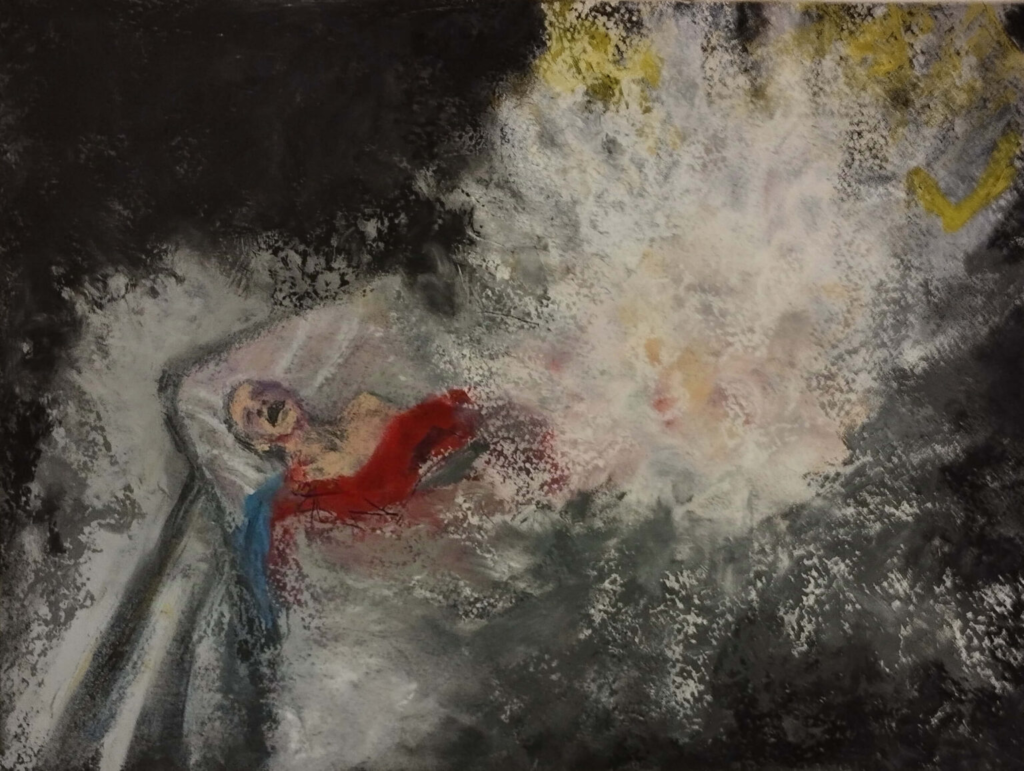
When I decided to write about Ciulli’s and my experience of Lewy Body Dementia, I felt a need to open my uninviting, black-bound journals for shreds of evidence of what had happened in the last four and a half years when both of us were held hostage to his disease. I was searching for notes, remnants, anything that might trigger memories and feelings. Instead I found myself becoming obsessed with finding one particular notebook in which I had recorded a dream I’d had twenty-five years ago—long before the onset of Ciulli’s dementia, long before the pandemic—a dream about the essence of Albert Camus’ writing. There was, and still is, a glow around my memory of that dream—luminescent numen, in a color there’s no name for.
Though my insistence on finding my first description of that dream seemed obsessive—in fact, I wondered if perhaps it was just an avoidance tactic—I recognized that peculiar lust I feel when following a scent in my work, so I persisted, rodent-like: I searched wildly in my home and in my studio for days and days, climbing up ladders to look in tucked-away corners of cabinets, and on my hands and knees tearing open and rummaging through boxes in my studio. I had a vivid yet scumbled sense of the dream. When I finally found it, I was astonished by the accuracy of my recollection, which had spanned across decades:
I’m in a Camus reading group. We discover that on a certain page, the miracle of Camus’ writing is revealed: Whosoever gets to page 188, their tongue becomes thick and swollen, making language impossible, and instead they must crawl on their belly to express themselves. This, according to the group, is the key to understanding the disease of Western civilization and its cure.

Whenever I remember the savage emotions in the dream and the inexplicable specificity of it, I can feel my blood coursing differently. The dream was dated 2000, when I was in my early forties, but Camus—his novels, essays, and polemics—had been one of my best friends since I dropped out in the tenth grade and ran away from home. And still, more than fifty years later, when I pick up any of his books, it’s like running into an old friend on a crowded street in a foreign city. In every piece of his writing, I feel the embrace of a remarkable person, who somehow can put into words our shared sense of alienation and loneliness as purely and precisely as he can describe his love, his solidarity—in a word, his friendship—with all humankind.
When I finally found the brief description of the dream in my notebook, I was particularly struck by the reference to page one hundred and eighty-eight. Like following a treasure map, I went to my very old, beat-up copy of The Plague and turned to page one hundred and eighty-eight; what I read encapsulates for me Camus’ genius:
“For nothing in the world is it worth turning one’s back on what one loves.”
The extra-sensory perception within the dream struck me: somewhere in a corner of my consciousness, I had stored that page number of The Plague. As I don’t have a photographic memory, and I’m not good with numbers, this detail was remarkable. For me it was a visceral reminder of the marvels stored in the corners of human consciousness, and an insight into how deep the hidden pockets of our deepest intelligence are.
In the years of caring for Ciulli, particularly in the last stages of Lewy Body Dementia, I was amazed to discover that the marvels of human consciousness are untouched by this devastating illness. Though his brain functioning was irreparably scrambled by the disease, I came to understand that Ciulli’s mind—by which I mean his deepest consciousness—was intact. You may feel that I am not in a position to make such a judgment, but I can argue that I am in a better position than most doctors and experts to do exactly that. Direct experience allows me to make such a statement, and also the following one: The animating force of human consciousness is love. Ciulli didn’t stop growing emotionally and spiritually as his disease progressed, nor did our relationship. Our marriage had never been simple or tranquil, but it was infinitely easier when we were forced to stop relying on words to communicate. In the last seven months of his life, he revealed treasures stored in the corners of his mind that defy rational thinking.
I appreciate rational thinking and recognize its importance in our world, but I also have long understood its limitations. Childhood traumas opened my eyes to the limits of logic very early on, and then along the way, I experienced other paradigms of mental activity. Dreams, meditation and martial arts; painting, writing, reading; psychotherapy and intimacy have all enlarged my understanding of our limitless minds, and how skewed our definitions of sanity and insanity can be.
About thirty years ago I had a dream I was talking to Descartes. I have no memory of ever having read his words directly—my knowledge of him is tangential, second-hand, limited to references in other books, footnotes, and some mentions of him in mathematics courses—nonetheless I had a vivid dream about him that I can recount without my record of it. His disembodied voice was extremely clear and spoke directly to my core:
“The Cartesian system is misunderstood; the space/time dialectic is misguided.
“The idea that space is on the y-axis and time is on the x-axis is nonsensical … because time doesn’t exist outside of matter: Time is a purple syrup embedded within all matter, infused in all living beings and nonliving things.”
Then he split a rock open to show me: I saw it: the purple syrup—it was unforgettable—indelible beauty, eternal.
If you step too far outside of our consensus reality—that arbitrary, illusory space/time grid we are trained to abide by—you are labeled insane, and quite possibly you will be hidden away from those you love until you die. Time doesn’t exist for people with dementia the way it does for people without dementia. This thing we call “time” lords over most of us in the Western world like an invisible tyrant creating fear and unbearable anxiety, demanding worship and greater and greater sacrifice. But dementia spits in the eye of time, of all behavioral norms, of any value system, of any system at all; it defies what we imagine human life is. Lewy Body Dementia stripped Ciulli of everything he treasured, yet ironically, it freed him from the prison of time and space.
Yet it would be grossly misleading to say that dementia liberated Ciulli: He became a prisoner to terrible delusions and terrors as well as the relentless, painful breakdown of his basic bodily systems. But I can attest to this: A person with Lewy Body Dementia can continue to learn and grow until the day they die. And intimacy and human connection is as crucial to the well-being and growth of a person with dementia as insulin is to a diabetic.
That purple syrup. Indelible beauty. Beyond space and time. Love itself.
Since Ciulli’s death in March 2024, my life has seemed like a phantasm, a broken toy; I remember my dreams from thirty years ago more vividly than anything I’ve experienced outside our apartment since March 2020. While external reality was being twisted like molten metal by the pandemic, my husband’s brain was being mangled by Lewy Body Dementia—but his mind, his deepest consciousness, was growing, evolving, and expanding, as was mine.
My experience of caring for Ciulli through the course of Lewy Body Dementia, concurrent with the global pandemic, concurrent with the appearance of new strains of fascism on nearly every continent, makes me concur with Camus: Being true to what one loves makes life worth living—even during a plague, even in the face of an incurable illness, even in the face of worldwide insanity.
What follows is not in chronological order.
[END of PART ONE]
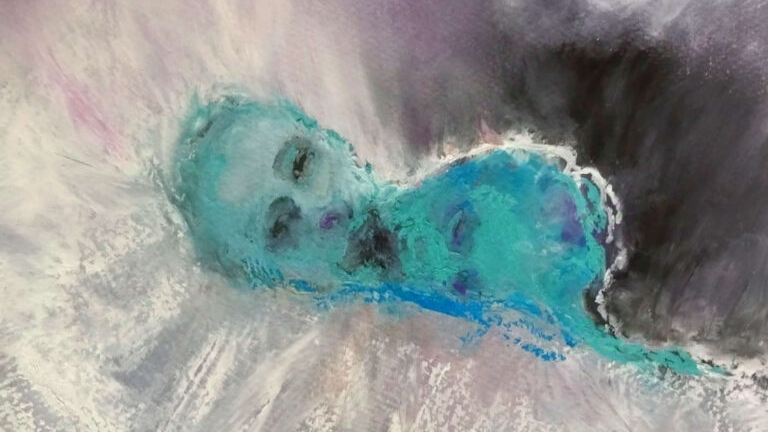
In copertina: particolare di AM Hoch, Couple in Bed, pastel on paper, 2024/25